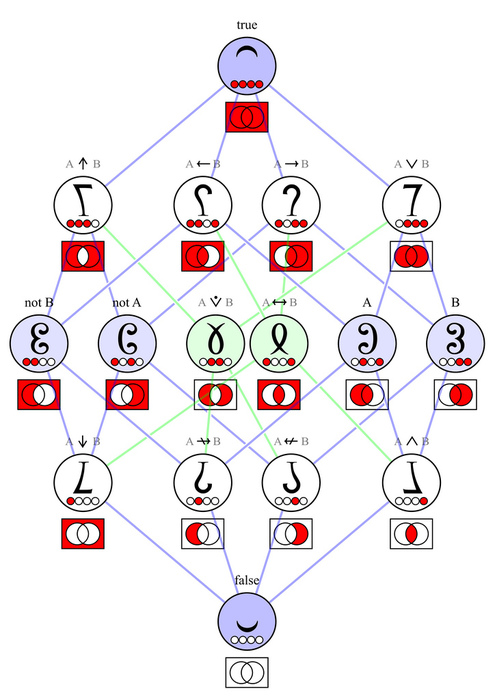
Propositional logic with a new “alphabet” for the Boolean operators. [More: Explanation & Related Logical Tautologies]
Propositional logic with a new “alphabet” for the Boolean operators. [More: Explanation & Related Logical Tautologies]
Six or seven years ago I had the idea to “write” a book where every sentence was copied from another work of fiction. This video is the movie equivalent in the form of a music video.

Mark Pilgrim explains his use of the GNU Free Documentation License for his books. The FDL explicitly gives anyone the right to publish the material themselves, which is exactly what one woman recently did much to the horror of the publisher Apress.
A cafe in Kashiwa Japan were you order for the next person in line, and receive what was ordered by the person in front of you.
The rules:

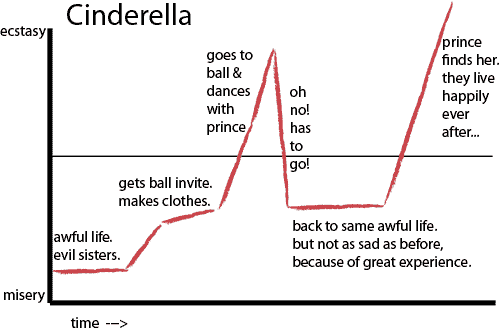
“The purpose of visualization is insight, not pictures.”
The on-going conversation in the comments is also worth a read.

Teaching a computer to fly using reinforcement learning.
(Watch Larger HQ Version.)
“The library will contain only books and paper journals. It will not have public access computer terminals. It will have a silent reading room, as well as a collaborative study room, in which laptops are allowed. There is no wired or wireless internet connectivity.
In return for all these restrictions, we will offer serene, quiet study/reading/research space, the best print collections money can buy, comfortable chairs and tables, and a return to the lovely, dusty book culture that some of us (and I think we’re still in the majority) remember, love, and think important.”
October 13-17, 2009 - Winnipeg, Canada
The annual week-long event focuses on sound: its production, its applications, its meanings, and its theories of production and reception.
“If anyone makes a claim of having constructed (programmed) a cognitive agent, that agent should show evidence of adhering to [these 6½ Fundamental Principles]. I submit that the fewer of these principles an agent employs, the less cognitively interesting the agent is.”
Sounds better than a Turing Test. ;)