Stung Eye

The eye of the bee holder.

Ordered Chaos

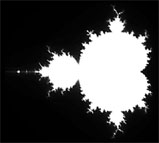
Thumbnail Image of a black and white Mandelbrot Fractal
The above image is a black and white representation of a Mandelbrot set, (the worlds most famous fractal), that I generated using Flash MX 2004. Chances are, you've seen one before. I saw one for the first time in the early 90s and it wasn't until today that I really understood how they were generated. I spent 6 hours today experimenting with this fractal in Flash.
For the lay person:
Imagine the Mandelbrot set as a cage for numbers. Once placed inside the cage, certain numbers can escape very easily, others have to struggle to escape, and some are doomed to remain for eternity. In the above image, these forever 'trapped' numbers are shown in white.
For the geeks:
The Mandelbrot cage wasn't designed for everyday numbers like 16 or 42. No, this cage was designed to trap numbers with imaginary components. The imaginary unit is i, where i is the square root of -1. ( i * i = -1. This is why we call it imaginary, for no real number multiplied by itself can yield a negative result.)
A complex number is one which has both a Real and Imaginary component, a + ib. (Where 'a' is the real component and 'b' is the imaginary component.) Complex numbers are added and multiplied differently than Real Numbers. Let's say I have two complex number, N and G, where N = a + ib and G = c + id:
N + G = (a + c) + i(b + d)
N * G = ac − bd + i (bc + ad)
For more information on complex numbers look here.
Our fractal image is built on a grid of complex numbers where the horizontal x axis represents the Real components and the vertical y axis represents the Imaginary components. The Mandelbrot set lives within the region defined by: -3 < x < 2 and -2 < y 2. (Let's call this the Mandelbrot Plane.)
The mathematical cage is defined as follows:
1 - Let C be a complex number within the Mandelbrot Plane.
2 - Let Z = 0.
3 - Find the next value of Z according to this formula: Znew = Zold * Zold + C
4 - Repeat step 3 until Z falls outside of the Mandelbrot Plane (i.e. the number escaped from our cage)
(If Z is truly trapped in our cage we will be able to repeat step 3 infinitely. Therefore, we can assume that our point C belongs inside of the Mandelbrot Set after a fixed number of iterations has been performed. In my flash experiments below, I used a maximum iteration value of 20.)
***
I wrote a collection of Flash Mandelbrot generators today using Actionscript 2.0. I created the first four demos before I realized that I could halve the processing time by assuming that the fractal was symmetrical. Flash was not designed for this kind of number crunching. (Time to learn processing for Java). Please note that images generated by these Flash applets are highly simplified representations of the Mandelbrot set. This is due to both their scale as well as the maximum iteration value I chose. (For a more detailed view visit the Julia and Mandelbrot Set Explorer.)

Note:If you have a slow computer or if you are fairly impatient you can skip the Flash experiments and download an image of their rendered output.

In these first two examples the 'trapped' Mandelbrot numbers are shown in black. The other numbers are displayed in blue according to how fast they escaped from the cage. (The larger and brighter the pixel, the quicker it was able to escape.)

Sideways Mandelbrot with Pixel Scaling and Shading. (Low Rez) - Pre-rendered image
Sideways Mandelbrot with Pixel Scaling and Shading. (High Rez) - Pre-rendered image

These two examples are identical to the previous two, other than the fact that the pixel scaling is now random. (Pseudo-Random)
Sideways Mandelbrot with Random Pixel Scaling. (Low Rez) - Pre-rendered image
Sideways Mandelbrot with Random Pixel Scaling. (High Rez) - Pre-rendered image

Using white circular pixels. (Scaling and brightness are again determined by escape speed.)
Sideways Mandelbrot with Circular Pixel Scaling. (Low Rez) - Pre-rendered image
Sideways Mandelbrot with Circular Pixel Scaling. (High Rez) - Pre-rendered image

A more 'classical' looking Mandelbrot, where the pixel colour represents the escape speed.
Sideways Mandelbrot with Colour Circular Pixel Scaling. - Pre-rendered image

Click here to see some Mandelbrot images I generated using Flash and Photoshop.
***
In my last post I mentioned the Buddhabrot, a sideways Mandelbrot which resembles an image of the Buddha sitting in meditation. This Buddhabrot is generated using the same mathematical 'trap' I described above. However, "If the [complex number] escapes [from the trap] [...], its path is reiterated, exposing its position onto the image surface with each step. In this fashion, areas of dense particle travel appear bright white." In other words, the Buddhabrot is a visualization of the escape path of all the points which don't belong in a Mandelbrot set. Cool!


the tyranny of framing our attention


Click on the above thumbnails to view photos.

***
I came across a monkey tail plant while wandering within the woods. Soon after, I was approached by two men with tape recorders strapped to their backs. They wanted the music that was playing in my walkman. I explained my search to them; the quest for contemporary origami. Hopefully the origami zine I picked up in town would provide the necessary clues.
I continued walking. My mind began to drift back to my warm room and the meditative nature of crafts.
Lost in thought, an idea arose: "What if we gave it all away?"
More ideas flooded the pathways: The visual nature of language; Is the Mandelbrot set fractal simply an image of the Buddha sitting in meditation (more buddhabrot); what's on the other side of the...
***
Update:
For Dad: Illuminated Printing.


Blunt Sharpie Cursive

The word on the street is that I'm engaged. It was romantic and exciting. I think this song says it all: Semisonic - Secret Smile. (offline)
***
I've long been fascinated by the link between music and mathematics. Chef Quix pointed out a very well written essay on math's relationship to music and life in general.
"Math is about thinking. Math is about problem solving. Math is about working with what you do know to give you a framework and a method of exploring and understanding what you don't know, about seeing relationships and patterns. Mathematics is a mind-set, and an attitude when you face something you do not understand. But there is also a beauty and a wonder about mathematics that only insiders know about. Words like elegant and beautiful are used constantly by mathematicians to describe paths of reasoning and proofs."

It's interesting to note that computer programmers react similarly to the esthetic beauty of well written code. I've read mathematical proofs and chunks of assembly code that honestly share the same emotional impact as expertly crafted poetry. The act of writing code can often lead to a meditative-like state ("the zone"), where the conversion of human ideas into a programming language becomes second nature. I've experienced similar "zones" in the worlds of mathematically problem solving and music composition.
"There are many things in music that are obviously math-related, and many musical notions can be explained in numbers. But it is important to note that numbers are not some way to describe music-- instead think of music as a way to listen to numbers, to bring them into the real world of our senses."
This ties in very well with the book Magister Ludi by Hermann Hesse. The central idea of the book is that of a mystical Bead Game. The game, originally developed as a musical improvisation/composition tool, evolves into a universal language of the intellect. I know I mentioned the fascinating logic tools developed by HipBone games in a previous post, but they really deserve your attention. Much like the Bead Game, these games are based on the complex relationships between abstract ideas/concepts.
The Rules:
"Two players play a game by each naming an idea in turn to one of the ten positions on the board. Ideas can be placed in any unoccupied position on the board.

Ideas can take the form of text, sound, or image: a quote, an equation, a musical theme, a video clip, or a photo or graphic are all acceptable. Essentially, a move can be made out of anything in the three worlds... so long as it can be named.

Players score by claiming links between the idea in their own move and the ideas already in play in those positions on the board connected to it by the lines of the board in question. A link can be any form of association - similarity, opposition, cause-and-effect, metaphor. Fanciful links may be made and enjoyed - or hotly contested.

The idea placed in the first move cannot score, since there is no other idea on the board for it to link with. The idea placed in the second move cannot score either, to keep the playing field even. Thus each player gets to make five moves on a ten position board, of which only four are scoring moves."
Several game boards have been designed to foster different styles of play: The waterbird and circuit boards are actually identical in terms of interconnects. The Psyche board is derived from the Pythagorean "tetraktys" diagram and can be used to assist with dream and symbol analysis. The comparisons board is used to compare and contrast two subject areas, or thinkers. The Pentagram and Mercedes boards (topologically identical with different symmetries), can be used in relation with each-other for more involved game-play. (Reminiscent of music transmogrification.)
Digest this sample game and you will see how these boards can be powerful learning/teaching tools.


  • Ping-Pong Ball Avalanche
  • Consciousness and The Brain - Annotated Bibliography
  • tinygrow - Grow an addictive virtual garden
  • Cut and Paste - A History of photomontage
  • Iconomy goes out in style - "the most linkalicious weblog post ever"


  • Honey never goes bad (a.k.a. sweet teeth)

    Notes from the dovecote comes from a good family. Addictive micro-fiction accompanied by mysterious apocryphal photo-creations. (Siblings: Speckled Paint and Solipsistic. Dovecote: A compartmental structure, often raised on a pole, for housing domesticated pigeons.)
    I can imagine the grin Escher would develop while watching this animation based on this woodcut. (Escher at the Artchive.)
    Gravity Zero has started posting entries from an found journal. "Almost 30 years later, the analog curves of her pen and pencil entries find their place in the electronic hum of our disembodied choir." (via i@Squub.)
    I have quite a few links to dole out today. Is it preferable to post them as a bulleted list of links, or in paragraph form? I'm drawn to description.
    I've always maintained that consciousness and self-awareness need to be measured on a sliding scale. (As apposed to the popular view of haves/have-nots. Where certain organisms are simply organic machines, and others are mystically given the ability to make premeditated value assumptions.) When viewed on a sliding scale we see that it is difficult, (but not impossible), to foster conscious communication with organisms that posses less complex 'souls'*. It is very easy to discount the consciousness of less evolved organisms. However, there was a time in the distant evolutionary past when our ancestors were 'less evolved organisms'; animals in our current sense of the word. Interspecies communication is always compelling. The BBC is carrying this article on the stunning oratory skills of a captive African Grey parrot.
    *The term 'soul' is used here as the root of complex organism consciousness and not necessarily as a religious construct.

    Harmonia Macrocosmica, by Andreas Cellarius, is an atlas of the heavens as seen by Copernicus, Ptolemy, Brahe and Aratus in the mid 17th century. All 30 double-folio hand-painted color plates along with 200 odd pages of Latin text are available for our perusal. (Dad, check this stuff out!) [via pelp]
    The Rough Guide to... is a musical adventure of quality discoveries.
    Some drone and ambient music downloads served using the Freecache content distribution system provide by archive.org.
    Is Canada a crucible of campus radio? The two campus stations here in Winnipeg are top-notch. Listen online: CKUW - UMFM
    Mike has been posting some great experiments in colour and focus.
    A hauntingly bizarre missing poster found by Andrea over at This Afternoon is Drama. Classic Lynchian reality.
    Imagine if we could plant flowers all over war-torn countries. Flowers who's petals would change colour when their roots came across land-mines. Now replace 'flowers' with 'genetically modified wheat' and it's a reality.
    I hope that you find the new colour scheme pleasing.
    Note to the surfer who found there way here via this search: There are no scary places in Winnipeg. Well, unless you count the entire -38 degree Celsius city last night.


    Bisous

    We'll start today's post by opening up the old mailbag:

  • Greg, from the Scottish funk band Nacoya sent me a note to alert me of their new website. (I saw Nacoya at the Pyramid in September of 2002. groovetasticfunksoulfusion.)
  • Nico from rapkings radio, sent me an updated link for their wonderful German hip-hop streaming radio station.
  • Over the past few days, I've started to receive a bizarre new type of spam. The emails do not appear to have any commercial content. In fact, they appear to be composed of stream-of-consciousness lists of random words. An example:
    "Subject: Re: CYKBYGI, whether pushkins poetry
    peptide pollinate paragraph forgave prophet
    topeka gimbel congeal pull ironwood detract behave
    chicagoan featherbed asset estimate greenish filmdom detonate lavish threefold functor"

    I've received 8 similar messages since Saturday. Any ideas?
    ***
    The Mars Rover Mission Blog includes a detailed time-line of the latest Mars rover landing sequence. (The images were taken from this amazing digital animation. The complexity of this mission is a true testament to the art of Engineering. For all you conspiracy theorists, NASA is *not* altering the colour of Mars.)
    The ESP game is a playful study of PSI and collective intelligence.
    Making the Mind - Why we've misunderstood the nature-nurture debate.
    Musicplasma - The music visual search engine. (wicked.)
    Quoted from boom selection: "[F]using together what seems like thousands of tracks with his inevitable talent, strictly kev has pulled what i think is one of the finest, cleverest examples of mixing i have ever heard. if bootlegs are dead, this is it's eulogy." Hop on your favourite p2p and search for: "Strictly Kev History Of The Cutup". The track-listing.
    Captain Kangaroo dies at 76. A quote: "Play is the work of children. It's very serious stuff. And if it's properly structured in a developmental program, children can blossom."


  • The play's the thing

    This weeks audio experiment was an exercise in Mixing, Mastering and EQing. The track was built around a bassline played by my friend Cam during a jamming session. The tracks tentative title was Slam It. In the end, I couldn't get Cam's bassline to sonically fit with the rest of the track; the bassline was replace.
    Download Cam Slam Track.
    ***
    The free boardgames over at HipBone are wonderful. Explore!

    From the hipbone website: "Your own mind is what you bring to the HipBone Games: your thoughts are the "pieces", the "cards" you play with. Whatever you know, think, or can guess or remember, whatever you can jot down, thumbnail sketch, whistle or quote is what you bring to the game, what you play the game with. We just supply the rules and the board.
    The result is that a HipBone Game is like a conversation: it finds its own level.
    And whether you are book-learned, experience-rich or streetwise, a visual person or someone with a knack for mathematics, funny or deadpan or serious, a lawyer or an artist, a geek or a jock or whatever, intuitive, spontaneous, considered or cautious, prone to telling tall tales, or precise as only a scholar can be -- it doesn't matter. The game will take on the form of your own mind, interacting with the minds of those you play with."

    The HipBone games are based on the concept of the Glass Bead Game described by Hermann Hesse in his Nobel-winning novel, Magister Ludi. I discovered the game site by chance as my dad recently gave me a copy of Magister Ludi. (Related: 1 - Read Hermann Hesse novel Siddhartha online. 2 - The HipBone Blog.)
    ***

  • Well designed blogs.
  • Depressed Canadians. (Number of weeks depressed in past 52 weeks, by age and sex.)
  • Canadian writers earn an average of $7,000 a year - To some authors, the upside is `real life' experience. (via wood s lot)


  • no-thing

    My gf has started bringing me to the gym. I've also just begun a yoga class with my mom and sister. My body feels sore and relaxed. It's the good kind of sore. My DJ follows me everywhere. Lately, I've been thinking about reading the bible. Today I stumbled across the bible for the IRC generation.
    Julian Jaynes had an interesting take on the evolution of consciousness. His book, The Origin of Consciousness in the Breakdown of the Bicameral Mind, caused a stir in both science and pop culture.
    "His basic thesis is that 'consciousness' is a modern development, arising in the last 3000 or so years. I can probably only give a gross caricature of his idea, but it suggests that the age preceding consciousness, the bicameral era, included the world portrayed in Homer's Iliad and the beginning of the Old Testament. In that age, one half of the brain (left) organised the ordinary business of doing things, eating, seeing, and ordinary sort of stuff, while the other (right) half did more, long-term sorting out of strategy. The brain's owner more or less trugged along on autopilot under the direct control of the left side until a totally new or unexpected situation, (in which we would use conscious thought) occurred. At this point, if the right half had any good ideas, it communicated them to the left, in a linguistic way. In other words, of course, the autopilot heard voices, giving instructions on what to do next." - Text from the last link.
    (Related: The Julian Jaynes Society - An archived stungeye post on consciousness)
    I just adore clouds. I'll bet you that Cary Grant did too.


    Check your head

    Playing with the new brushes in Photoshop:

    It was snowing last night. The snow flakes looked like stars:

    Legs:


    The Under Toad

  • All Consuming's, most blogged about books for 2003.
  • horizonzero.ca - Digital Art + Culture in Canada.
  • Buddha was a Lumberjack
  • Sounds Like Techno (flash)
  • the first vienna vegetable orchestra
  • Languagehat - A language blog.
  • A nifty flash demo. (Drumming)
  • 101 things to do in 1001 days.
  • Dunun - An inventive use of flash navigation.
  • Manual - An instruction manual for the creation of art.
  • dentokogei.com - devoted to showcasing the work of the shokunin, or artisans, still working and carrying on the traditions of handcraft production in Japan.
  • A pink tank?

  • Past Wonder

    Today's Flash MX 2004 experiment is: Bees - A Sidescrolling Video Game.
    This game took me quite a while to complete. I've been working on it, on and off, for about a month now. If anyone is interested in checking out the source file, feel free: Bee Sources (example fla). The file may be a bit hard to understand as there are few comments, and I was busily climbing the learning curve while I was building the game.
    If you are using Mozilla or Opera to view this flash experiment I recommend you upgrade your Flash plug-in to version 7.0.
    ***
    Download winamp 5. Use their new Media Library (ALT-L). Load up the video stream entitled demoscene stream in the Internet TV section. Enjoy your fill of the old school demo scene. (Other winamp streams of note: The 1000kbps Bjork promo stream, #Rapkings - German, French and American hip-hop. Rapping sounds wicked cool in German and French.)
    The demo scene stream lead me to Pouet.net, a scene related resource centre. From there I discovered a real treat! (More info on that, later.)
    Back in the early 90s, I was into the local BBS scene. I witnessed the peak and the near-death of this digital phenom. Before the internet gained wide spread popularity, millions around the world were using their computer modems to connect over their phone lines to Electronic Bulletin board systems. There were even globally connected BBS networks like Fidonet that rivaled the early 90s internet in terms of ease of use, community strength and content. Worldwide communities were formed that promoted the distribution of knowledge, creativity and the fellowship of man. Of these communities and scenes, I was drawn to phreaking, hacking and the demo and ansi-art scene. I remember when my cousin first taught me how to make free long-distance modem calls through the Univerisity of Manitoba loopback switch. The world's BBS systems, like giant digital community built encyclopedias, were at my disposal.
    This is where I learnt to love learning. Using the word "where" in this context is such an abstraction. For "where", was I while I soaked in this info from this proto-noosphere? I was at home. Sitting in front of my computer. And yet my consciousness was connecting to people and ideas around the world. Bringing 'home' some inspiration from a beautiful ANSI image created in Germany. Debating the finer points of shareware video games on a BBS in Hawaii.
    And then I discovered the Net. Sure, sometimes I miss the BBS world, (especially it's lack of corporate sponsorship), but there's no turning back once you witness the future.
    The treat I mentioned earlier is the final Artpack from the legendary ANSI-art crew, Acid Productions. These digital artists weave complex images with a limited colour palette and a collection of squares. (Download with BitTorret: acid-100.zip.torrent)
    ***

    "These 9 drawings were done by an artist under the influence of LSD -- part of a test conducted by the US government during it's dalliance with psychotomimetic drugs in the late 1950's. The artist was given a dose of LSD 25 and free access to an activity box full of crayons and pencils. His subject is the medico that jabbed him."
    What blew me away was the similarity of this image with the painting composition work of Wassily Kandinsky
    ***

  • Their Circular Life.
  • Some dope rappers: Extended F@mm
  • Another release from soulseekrecords: New Delhi FM - Far From Yesterday. (I just love how soulseek has used their underground p2p system to start a record label!)
  • A blogging milestone for Chef Quix.


  • Two Rivers

    The current temperature is -31°C (-24 F). Our car is frozen solid and I've drained the battery dead while trying to start it. I'll try to boost later on today. Hopefully the block heater will have done it's job by then.
    I've got some links to hand out. Let's do this paragraph style instead of a bulleted list, this time around. The people at creative commons have launch two sampling copyright licenses free for public use. Much like their other public licenses, the sample licenses will allow content creators to fuel the global creative process.
    "The Sampling licenses will help authors foster a broad range of culture, from photo collage to musical "mash-ups," that the law currently deems illegitimate. [...] The Sampling license will let authors invite others to transform their work, even for commercial purposes, while prohibiting distribution of verbatim copies, or any use in advertising.
    For example, an artist could take a photo licensed under Sampling, crop it, and use it in a commercial collage, but she could not distribute simple copies of the whole, original photo. A DJ could borrow elements of a licensed song, royalty-free, and use them in an original piece. He could not, however, put a copy of the tune on a file-sharing network."

    I stumbled across some great philosophical musingss over the holidays. This thread over at Information Pollution has been attracting some interesting discussion. The seed of these discussions was the trailer for the movie 21 Grams, which states that a human body loses 21 grams of mass at the moment of death. (Proof of the existence of a soul?) This thread eventually lead me to C. C. Keiser's musings on Poly-Solopsism and existence, (complete with philoso-poetry.) From there I discovered panentheism.com, a website "dedicated to the creation of a Universal Philosophy for life universally and for humankind in particular using the metaphysical concept of Symbiotic Panentheism." Inspired, I teased the following out of google: Telespace.org - A game-player's guide to reality. Where the author presents his working hypothesis, that "reality may be an interactive fiction -- a game -- designed to promote the evolution of consciousness at all levels."
    The Triplets of Belleville looks like a wonderful new animated feature. Watch the trailer here.
    In music news, the Onion A.V. Club has posted their best albums of 2003 lists.
    Kottke and Fimoculous are two fine blogs.