Discovered on December 6, 2008
Pirates of the Amazon Abandon Ship
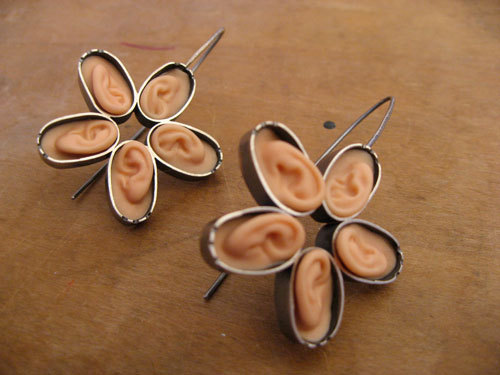
Hearrings [via]
Dutch students “release a Firefox extension that made it easy for people who were browsing books, music and movies on Amazon to download the same products free through the Pirate Bay, the illicit BitTorrent site.”
Amazon serves a take-down notice. Students comply.
Student defend their work as parody:
“[Amazon and the Pirate Bay] might look like opposites, but are actually quite similar in regards to the mainstream media content they provide. Our project demonstrated this practically. So it’s a parody of any kind of media consumerism, whether corporate or subcultural.”
The students weren’t hosting or providing pirated media. They were pointing the way. Will this eventually lead to world governments enacting legislation that limits certain types of linking on the net? Might it eventually be illegal for me or Google to link to the Pirate Bay?
Source: tnyt
I drank the dead man’s scotch straight from the bottle.
— A sentence Michael Van Rooy, Aqua Books Writer in Residence, wrote this week while working on his third novel upstairs at 274 Garry.
Discovered on December 4, 2008
Discovered on December 2, 2008

Mysterious Attainment from a Winnipeg-based FlickrStream. Be sure to read the photo titles.
Contains this beautiful maxim: “Never step on anything you can step over. Never step over anything you can step around.”
An immortal jellyfish.
“The ability to reverse the life cycle is probably unique in the animal kingdom, and allows the jellyfish to bypass death.”
Discovered on November 30, 2008
Discovered on November 27, 2008

Aquabooks. Have you checked out their new digs?
“274 Garry Street in the benevolent capitalist shadow of Portage and Main.”
Obsessed with putting ink on paper
The inner workings of the LilyPond music notation system. You might have to be three-kinds-of-nerd* to get into this one. ;)
*Music, Typography, CompSci
The Worse Day of His Life
Discovered on November 26, 2008

via L’Aureola
A Process That Resonates
Processing is a free open-source programming language for people who want to program images, animation, and interactions. It was created with artists, designers and hobbyists in mind.
After seven years of alpha and beta testing version 1.0 of Processing was launched yesterday.
I first discovered Processing in late 2003 and started coding sketches in February of 2004. Since then I’ve logged countless hours geeking out with this wonderful tool. I published my early sketches online, but I think the last sketch I shared on StungEye was a crystal growth simulator back in October of 2007.
Lately when I want to do some experimental coding I pull out my Ruby Shoes, but I have started teaching some of my students how to write programs for their cellphones using the mobile version of Processing.
I also own an Arduino, the electronics-hacking version of Processing. Next week Andrew and I are going to use an Arduino to build a random number generator. Why? Well, for use as a consciousness field resonator to test the existents of the Noosphere, of course. :)
BTW, if you want to see what’s possible with Processing check out the work of Robert Hodgin or Glenn Marshall.
If you want to learn Processing you can get started by following the tutorials and the API reference. You can learn from and be inspired by other peoples code. I also recommend the book Learning Processing by Daniel Shiffman.
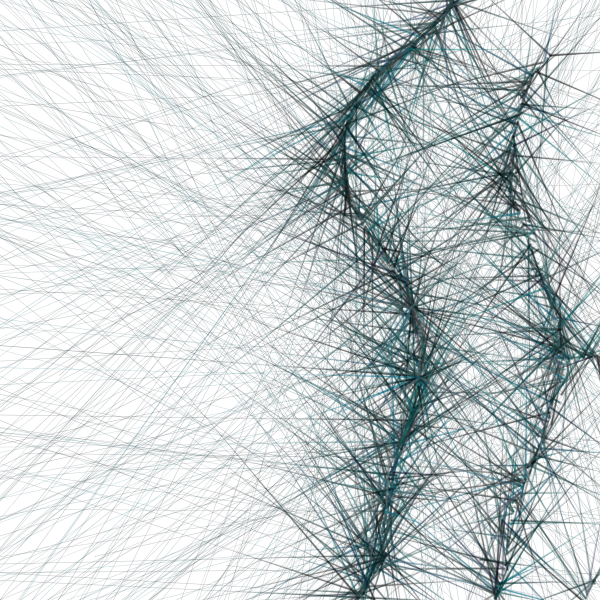
Computational Expressionism: “Where an artist programs a drawing tool and then uses it to create their own drawings.”
More: An Active Essay on Computational Expressionism (Follow the arrows…)
Discovered on November 20, 2008

424 River Ave, Winnipeg. via aggie @ some life
Then as Victoria Hospital. Now as River Manor Apartments.
“But the day when music is finally and irrevocably reduced to syntactic pattern and pattern alone will be, to my old-fashioned way of looking at things, a very dark day indeed.” —Douglas Hofstadter